
Philippine Communities Demand World Bank Reinvest $39 Million of Toxic Returns in Remedy for Affected People

The World Bank's private sector arm pocketed millions from an equity investment in a Philippine bank, while spending nothing on remedy for the harm caused by 10 new coal-fired power plants it financed.
MANILA, 7 October 2026 — On the eve of the World Bank Group Annual Meetings in Bangkok, new analysis reveals the International Financial Corporation (IFC) and its Capitalisation Fund made an estimated US$39 million in total return from its investment in a Philippine bank, whose financing of coal-fired power plants left a trail of destruction affecting more than 120,000 people.
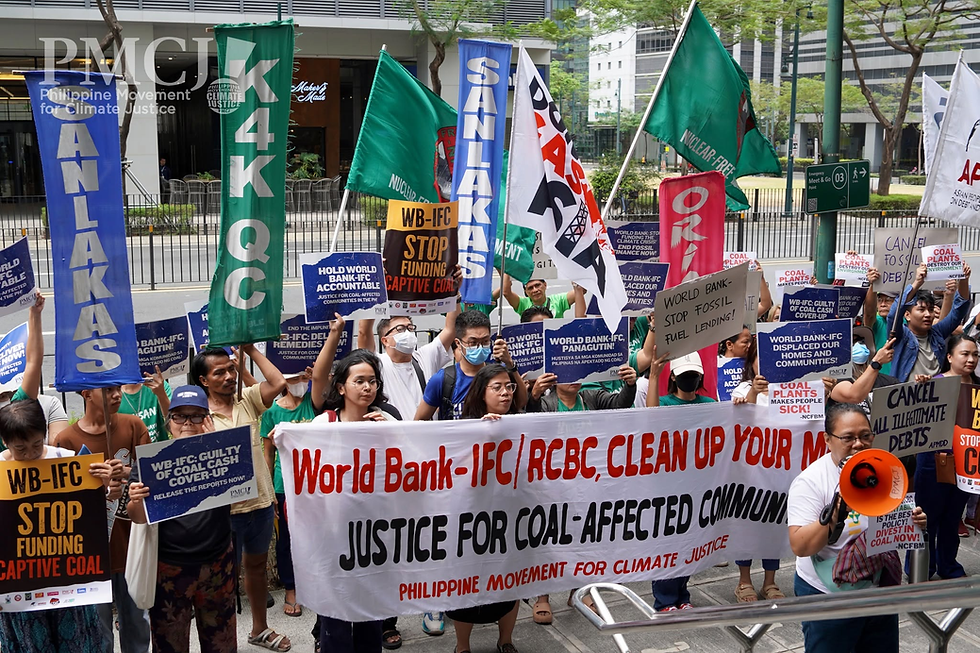

“Our people continue to bear the devastating consequences of IFC’s profiteering,” said Aaron Pedrosa, complainant representative and legal counsel of the Philippine Movement for Climate Justice (PMCJ). “While the bank amassed millions, frontline communities in the Philippines were forced from their lands, suffered respiratory diseases, and faced violence and intimidation for speaking out. Fisherfolk, farmers, and Indigenous Peoples have lost their livelihoods and local ecosystems have been destroyed. The bank to this day has not spent a single dollar for much-needed remedies as impacts continue to be lived realities for affected communities throughout the Philippines. The bank can afford to fund community-level interventions to address livelihood, environmental and health impacts. It has chosen to do nothing.”
The analysis published today uncovers a calculated commercial strategy. Between 2011 and 2013, the IFC and the IFC Capitalisation Fund acquired a significant stake in Rizal Commercial Banking Corporation (RCBC), investing nearly US$148 million. It held shares for 13 years, earning more than US$25 million in dividends from RCBC’s earnings. Despite holding a designated seat on RCBC’s Board of Directors, the IFC stood by as its client bankrolled new coal-fired power plants. The IFC sold shares in 2015 and again in 2025, generating nearly US$14 million in capital gains. This brought the IFC’s total return to an estimated US$39 million.
PMCJ, IDI and Recourse are calling on the World Bank Board of Directors to surrender the IFC’s multi-million-dollar windfall to those who were harmed by the RCBC investments by contributing to a dedicated fund for the coal-affected communities.
“This case is the ultimate test of the World Bank’s institutional integrity,” said David Pred, executive director of Inclusive Development International (IDI). “The IFC cannot treat human suffering as a profit-making strategy. While IFC has made a financial killing, thousands of Filipino farmers and fisherfolk are paying the price with their health, livelihoods, and environment. IFC’s Remedial Action Framework exists precisely for these moments – to enable remedy throughout the project cycle and to step in and address harms directly when its clients are unable or unwilling to do so. The World Bank Board must reject the IFC's excuses and uphold its development mandate by redirecting the returns it earned from the RCBC investment to alleviate the suffering of the impacted communities.”
Approved by the Board in 2025, the IFC’s Interim Remedial Action Framework (RAF) provides a structured approach to addressing harm arising from IFC investments. Under the framework, IFC can make contributions to remedial action on a case-by-case basis.
Following an investigation into IFC’s investment in RCBC prompted by a 2017 complaint, the IFC’s independent accountability mechanism, the Compliance Advisor Ombudsman (CAO), found that the IFC had contributed to environmental, social and climate-related harms associated with the RCBC-backed coal plants and concluded the IFC should contribute to remedying those harms.
Under its Board-approved Management Action Plan, IFC commissioned an independent gap analysis which confirmed that many of the community-reported harms could be attributed to the power plants and provided 186 recommendations to address the issues. However, following objections from RCBC to the findings, progress has stalled. IFC claims that it has exhausted all options and has refused to publicly disclose the gap analysis reports.
“Communities across the Philippines are relying on the Board to reject IFC’s total abdication of its responsibilities and restore the integrity of the World Bank on the ground,” said Daniel Willis, Upholding Rights Lead at Recourse. “The independent gap analysis provided 186 clear solutions to fix the harms. Yet, the moment RCBC objected, the IFC folded, hid the findings behind a wall of corporate secrecy, and refused to disclose them to the public. It is a travesty for the IFC to claim its hands are tied while its bank accounts swell with millions from this investment.”
As the coal plants continue to operate, affected people have demanded that the World Bank Group’s leadership not allow their communities to become sacrifice zones.

“The IFC made money from funding these coal plants. Now they made money again for selling its shares. That profit was made from our backs,” said Derek Cabe, complainant community member. “That money should go back to us and our communities that the IFC harmed. If the World Bank is serious about being a faster, simpler, bolder, and more efficient bank, there is no better way to prove it than paying for remedies.”
For more about this case, see here: https://www.inclusivedevelopment.net/cases/philippines-climate-change-and-ifc-lending/
Read Inclusive Development International’s analysis: “How the International Finance Corporation made an estimated total return of $39 million from its equity investment in Rizal Commercial Banking Corporation”
For interviews and other press inquiries, please contact:
For Inclusive Development International (in the US): Donovan Birch Jr, donovan@inclusivedevelopment.net, +1 828-505-4340
For Philippine Movement for Climate Justice (in the Philippines): Sheila Abarra, mediacommunications@climatejustice.ph, +63-9916692356
For Recourse (in the UK): Madeleine Race, madeleine@re-course.org, +44 7405351150


Comments